
Memory isn’t a fixed trait you’re born with. It’s a skill — and like any skill, it can be trained, protected, and even rebuilt at almost any age. In this guide, we’re going deep: the science of how memory actually works, the different types of memory you’re using every single day without realizing it, the daily habits that quietly wreck your recall, the techniques memory champions use to memorize entire decks of cards, the long-term lifestyle strategies that keep your brain young for decades, and a realistic day-by-day plan to put all of it into practice.
This is a long guide, because memory isn’t a “one weird trick” topic — it’s the sum of dozens of small, compounding habits. Bookmark it, come back to it, and use the table of contents to jump to what you need right now.
Table of Contents
- How Memory Actually Works
- The Different Types of Memory You Use Every Day
- Why Your Memory Feels Worse Than It Used To
- The Foundations: Sleep, Stress, and Blood Flow
- Best Brain & Memory Supplements in 2026:
- Nutrition for a Sharper Brain
- Memory Techniques That Actually Work
- Exercise and Movement for Cognitive Function
- Digital Habits That Are Quietly Hurting Your Focus
- Memory and Aging: What’s Normal and What Isn’t
- Common Memory Myths, Debunked
- Natural Supplements and Brain-Training Tools
- Memory at Work: Practical Strategies for Professionals
- Memory for Students: Studying Smarter, Not Longer
- Mindfulness, Meditation, and Memory
- Social Connection: The Overlooked Memory Booster
- Memory Techniques Deep Dive: Numbers, Faces, and Languages
- Real-World Scenarios: Applying These Habits
- Building a Daily Memory Routine
- A 30-Day Memory Improvement Challenge
- Tools and Resources Worth Exploring
- When to See a Doctor About Memory Problems
- Frequently Asked Questions
How Memory Actually Works {#how-memory-actually-works}
Before fixing memory, it helps to understand what’s actually happening in your head when you remember — or forget — something.
Memory isn’t stored in one single place in your brain, and it isn’t a single process either. It’s a multi-stage pipeline, and most “memory problems” are actually breakdowns at one specific stage, not a general failure of “having a bad memory.”
Stage 1: Encoding
Encoding is the process of converting what you see, hear, smell, or experience into a signal your brain can actually store. This is where the vast majority of everyday memory problems begin — and it’s the stage people almost never blame.
Think about it this way: if you meet someone at a party, get their name, and thirty seconds later can’t recall it, you probably didn’t actually forget it. You never properly encoded it in the first place, because you were half-listening while thinking about what to say next, glancing around the room, or holding a drink and shaking hands at the same time. There was nothing solid to lose.
Encoding strength depends heavily on:
- Attention — divided attention produces weak, shallow encoding
- Emotional relevance — emotionally charged moments are encoded far more strongly (this is why you remember exactly where you were during major life events, but not what you had for lunch three Tuesdays ago)
- Depth of processing — actively thinking about the meaning of information encodes it more strongly than passively hearing or seeing it
Stage 2: Storage (Consolidation)
Once something is encoded, your brain has to decide whether to keep it and, if so, move it from a fragile, temporary state into a more stable, long-term form. This process is called consolidation, and it relies heavily on a seahorse-shaped structure deep in your brain called the hippocampus.
Consolidation happens largely during sleep, particularly during deep, slow-wave sleep and REM sleep, when your brain essentially “replays” the day’s experiences and strengthens the neural connections tied to what you learned. This is one of the single biggest reasons sleep-deprived people struggle with memory — it’s not that they can’t focus during the day (though that’s part of it too), it’s that the consolidation process that would normally lock in yesterday’s learning never properly happens.
Stage 3: Retrieval
Retrieval is pulling stored information back up when you need it — recognizing a face, recalling a fact during a test, remembering why you walked into a room. “Tip of the tongue” moments happen when a memory is stored just fine, but the retrieval pathway to it is weak, blocked by interference from similar memories, or simply under-practiced.
Most people, when they say “I have a bad memory,” are actually describing a retrieval failure — and blaming their memory generally, when the real issue is often that the information was never encoded strongly to begin with. This distinction matters enormously, because it changes where you should focus your effort: improving memory is often less about “training your memory” as some abstract muscle, and much more about training your attention and the quality of your initial encoding.
The Role of Neuroplasticity
Underlying all of this is neuroplasticity — your brain’s ability to form new neural connections and reorganize existing ones throughout your entire life, not just during childhood. Every time you learn something and successfully recall it later, you’re physically strengthening a network of neurons. Every time you let a skill or piece of knowledge go unused, that pathway can weaken. This “use it or lose it” principle is the biological foundation for almost everything in this guide — memory genuinely can be trained, because the underlying hardware is adaptable.
The Different Types of Memory You Use Every Day {#types-of-memory}
“Memory” isn’t one thing — it’s an umbrella term for several distinct systems, each with different strengths, weaknesses, and training methods.
Working Memory
This is your mental scratchpad — the small amount of information you can hold and manipulate in your mind for a few seconds at a time, like remembering a phone number just long enough to dial it, or holding the first half of a sentence in mind while you read the second half. Working memory has a famously small capacity (often cited as “seven plus or minus two” items, though more recent research suggests it’s closer to four for most people). Weak working memory shows up as difficulty following multi-step instructions or losing your train of thought mid-conversation.
Short-Term Memory
Slightly broader than working memory, short-term memory holds information for roughly 20-30 seconds unless it’s actively rehearsed or transferred into long-term storage. This is the “waiting room” memories sit in before your brain decides whether they’re worth consolidating.
Long-Term Memory
This is where consolidated information lives, potentially for a lifetime. Long-term memory itself splits into two major categories:
- Explicit (declarative) memory — memories you can consciously recall and describe, which further splits into:
- Episodic memory — personal experiences and events (your first day of school, last week’s dinner with friends)
- Semantic memory — general facts and knowledge, disconnected from any specific personal experience (the capital of France, how photosynthesis works)
- Implicit (non-declarative) memory — memories that influence behavior without conscious recall, including:
- Procedural memory — skills and habits, like riding a bike or typing without looking at the keyboard
- Priming — being unconsciously influenced by prior exposure to a stimulus
Prospective Memory
This is the often-overlooked category: remembering to do something in the future, like taking medication at a specific time or picking up milk on the way home. Prospective memory failures (“I forgot I was supposed to call her back”) are extremely common and respond well to external cues and structured reminders, which we’ll cover later.
Understanding which type of memory is actually giving you trouble helps you pick the right fix. Constantly losing your train of thought mid-sentence points to working memory strain (often from stress or multitasking). Forgetting appointments points to prospective memory, which benefits from systems and reminders more than “trying harder.” Struggling to recall facts you studied points to weak encoding or insufficient spaced repetition.
Why Your Memory Feels Worse Than It Used To {#why-your-memory-feels-worse}
A few common culprits show up again and again when people describe feeling foggier or more forgetful than they used to be.
Chronic Sleep Debt
As covered above, memory consolidation happens primarily during deep sleep. Cut sleep short repeatedly — even by just an hour or two a night — and yesterday’s experiences never get properly filed away, while today’s ability to encode new information also takes a measurable hit. Sleep debt compounds; you can’t fully “catch up” with one good night after a week of short sleep.
Constant Background Stress
Elevated cortisol over long periods is associated with reduced activity and even shrinkage in the hippocampus, the brain’s central memory-processing hub. Unlike a single stressful event (which can actually sharpen memory of that specific moment), chronic, low-grade stress — the kind from ongoing work pressure, financial worry, or unresolved conflict — tends to impair the broader ability to form and retrieve memories.
Digital Multitasking and Fragmented Attention
Constantly switching between tabs, notifications, and short-form content trains your brain for novelty-seeking and rapid task-switching, not sustained focus. Since focus is the raw material memory is built from, a habitually fragmented attention span means weaker encoding across the board, even for things you actually care about remembering.
Nutrient Gaps
Low levels of omega-3 fatty acids, B vitamins (especially B12), vitamin D, and iron are all associated with foggier thinking and reduced cognitive performance. These deficiencies are more common than people assume, particularly in diets low in fatty fish, leafy greens, or animal products.
Sedentary Days
Physical movement increases blood flow and oxygen delivery to the brain and supports the release of growth factors involved in forming new neural connections. Long stretches without any movement — an entire day at a desk, for instance — can leave you feeling mentally sluggish by mid-afternoon, independent of how much sleep you got the night before.
Dehydration
Even mild dehydration (as little as 1-2% of body weight in fluid loss) has been linked to measurable dips in concentration and short-term memory performance. It’s one of the simplest, most overlooked factors in daily mental fog.
Alcohol and Substance Use
Alcohol directly interferes with the hippocampus’s ability to consolidate new memories — this is the mechanism behind blackouts, but even moderate regular drinking has been associated with measurable effects on memory performance over time.
The encouraging part of this list: nearly every item on it is reversible with consistent behavior change, and most people see noticeable improvement within weeks, not years, of addressing even two or three of these.
The Foundations: Sleep, Stress, and Blood Flow {#the-foundations}
If you only fix three things from this entire guide, fix these first — everything else works better once these three are in place, and very little works well if they’re neglected.
1. Prioritize Sleep Like It’s Non-Negotiable
Aim for 7-9 hours most nights. During deep, slow-wave sleep, your brain replays and consolidates the day’s experiences, strengthening the neural connections tied to what you learned. During REM sleep, your brain appears to work on integrating new information with existing knowledge, which is part of why “sleeping on it” genuinely helps with problem-solving and creative insight.
Practical sleep habits that support memory specifically:
- Keep a consistent sleep and wake time, even on weekends — irregular schedules disrupt the deep-sleep stages where consolidation happens most
- Avoid screens for 30-60 minutes before bed; blue light and stimulating content both delay the onset of deep sleep
- Keep your bedroom cool, dark, and quiet — all three measurably increase time spent in deep sleep
- Avoid caffeine within 6-8 hours of bedtime, since it can reduce deep sleep even if you don’t consciously feel “wired”
- If you learned something important during the day (a new skill, an important fact, a name you want to remember), review it briefly right before bed — this timing appears to give consolidation a head start
2. Manage Stress Daily, Not Just When It Gets Bad
You don’t need an hour-long meditation practice to protect your hippocampus. Even 5-10 minutes of slow, deliberate breathing, a short walk outside, or journaling can measurably lower stress hormones in the short term, and consistent daily practice appears to build longer-term resilience.
Simple, low-effort stress management tools:
- Box breathing — inhale for 4 counts, hold for 4, exhale for 4, hold for 4, repeat for 2-3 minutes
- A 10-minute outdoor walk, ideally without your phone
- Brain dump journaling — spending 5 minutes writing out whatever is on your mind, without editing or worrying about structure
- Scheduled worry time — if intrusive worries are constant, setting aside a specific 10-15 minute window each day to think through them (rather than letting them run all day) can reduce their overall grip on your attention
3. Get Your Blood Moving
Even light movement — a 10-minute walk, some stretching, a few flights of stairs, a couple minutes of jumping jacks — increases blood flow to the brain and supports the growth of new neural connections through increased levels of a protein called brain-derived neurotrophic factor (BDNF), sometimes nicknamed “Miracle-Gro for the brain” in popular science writing because of its role in supporting neuron growth and survival.
You don’t need a formal workout to get this benefit. The key variable seems to be frequency and consistency of movement throughout the day, not just one big session.
Putting the Three Foundations Together
Sleep, stress management, and movement don’t operate in isolation — they reinforce each other in a loop that can run in either direction. Poor sleep raises stress hormones the next day. Elevated stress makes it harder to fall into deep sleep that night. Chronic stress and poor sleep both reduce motivation to move your body, and lack of movement, in turn, is associated with worse sleep quality. The good news is that this loop works just as strongly in the positive direction: a short walk can reduce evening stress and improve sleep onset, and better sleep gives you more energy and emotional resilience the next day, which makes it easier to manage stress and stay active. This is why small, consistent improvements to any one of these three foundations tend to produce benefits that show up in the other two as well, even without deliberately targeting them.
Best Brain & Memory Supplements in 2026:
1. Neuro Zoom – Best Overall Brain & Memory Supplement
Neuro Zoom is a natural brain support supplement designed to improve focus, memory, and mental clarity. It contains ingredients that may help support healthy brain function and reduce mental fatigue. It is suitable for adults who want better concentration and cognitive performance. While results vary, consistent use alongside a healthy lifestyle may provide the best benefits.
2. Pineal Guardian – Best for Daily Cognitive Wellness
Pineal Guardian is formulated to support brain health and overall cognitive wellness. Its blend of natural ingredients aims to promote mental focus, healthy circulation, and long-term brain function. It may be a good option for people looking for daily cognitive support, though individual results can differ.
3. BrainSync – Best for Focus and Productivity
BrainSync is a daily brain supplement created to enhance concentration, memory retention, and mental performance. It combines natural ingredients that may help reduce brain fog and improve productivity. It works best when paired with proper sleep, nutrition, and regular exercise.
4. ProMind Complex – Best for Long-Term Memory Support
ProMind Complex is designed to support memory, focus, and healthy cognitive aging. Its ingredients are selected to help maintain brain performance and mental sharpness over time. It is often chosen by adults who want to support long-term brain health naturally.
5. NeuroPrime – Best for Mental Clarity
NeuroPrime is a brain health supplement that focuses on improving mental clarity, learning ability, and focus. The natural formula may help support healthy cognitive function and reduce occasional forgetfulness. Regular use and healthy daily habits can contribute to better results.
Nutrition for a Sharper Brain {#nutrition-for-a-sharper-brain}
Your brain uses roughly 20% of your daily energy despite being only about 2% of your body weight — what you feed it matters more than most people realize.
Brain-Supportive Foods to Lean Into
- Fatty fish (salmon, sardines, mackerel, trout) — rich in omega-3 fatty acids, particularly DHA, which is a major structural component of brain cell membranes and is linked to healthy brain structure and function
- Berries (blueberries, strawberries, blackberries) — high in antioxidants called flavonoids that may help reduce inflammation linked to cognitive decline
- Leafy greens (spinach, kale, collards) — packed with vitamin K, lutein, folate, and beta carotene, a combination associated with slower rates of cognitive decline in observational studies
- Nuts and seeds (walnuts, almonds, flaxseed) — good sources of vitamin E and healthy fats, both associated with reduced age-related cognitive decline
- Eggs — contain choline, a nutrient your body uses to produce acetylcholine, a neurotransmitter directly involved in memory and mood regulation
- Whole grains — provide a steady glucose supply to the brain, which relies heavily on glucose as its primary fuel source
- Dark chocolate and coffee (in moderation) — flavonoids and caffeine have both been associated with short-term cognitive benefits, including improved focus and alertness
- Turmeric — contains curcumin, which has antioxidant and anti-inflammatory properties under active research for potential brain benefits
What to Cut Back On
- Excess added sugar — linked to inflammation and, in some studies, impaired memory over time, particularly with chronically elevated blood sugar
- Ultra-processed foods — tend to displace nutrient-dense options and are often associated with poorer cognitive outcomes in long-term dietary pattern studies
- Heavy or frequent alcohol use — directly interferes with memory consolidation, as covered earlier, and heavy long-term use is associated with structural brain changes
- Trans fats — found in some fried and packaged foods, associated with worse memory performance and increased brain inflammation in various studies
Hydration
Water might be the single most underrated brain nutrient. Even mild dehydration measurably affects concentration, short-term memory, and mood. A simple habit: keep a water bottle visible on your desk and refill it at set points during the day rather than relying on remembering to drink when thirsty (by the time you feel thirsty, mild dehydration has often already set in).
A Note on “Brain Foods” and Realistic Expectations
No single food is a magic bullet, and no amount of blueberries will undo months of poor sleep or chronic stress. Nutrition works best as part of an overall pattern — the Mediterranean diet, in particular, has some of the strongest research behind it for long-term brain health, largely because it combines many of the foods above (fatty fish, leafy greens, nuts, olive oil, whole grains) while limiting processed foods and red meat.
You don’t need to overhaul your diet overnight. Small, consistent swaps — adding a handful of berries to breakfast, choosing fish over red meat twice a week, snacking on nuts instead of chips — compound significantly over months.
Memory Techniques That Actually Work {#memory-techniques}
These are the same tools memory champions use to memorize entire decks of shuffled playing cards or hundred-digit numbers — and they work just as well for everyday life, not just competition tricks.
The Memory Palace (Method of Loci)
One of the oldest and most well-documented memory techniques, dating back to ancient Greek and Roman orators. Picture a place you know extremely well — your childhood home, your daily commute, your current apartment. To remember a list, mentally “place” each item somewhere along a familiar route through that space, making the image as vivid, strange, or exaggerated as possible (the weirder the image, the more memorable it tends to be). When you need to recall the list, mentally walk through the space again, and the items appear where you left them.
Example: To remember “milk, batteries, birthday card, dry cleaning,” you might imagine walking through your front door and tripping over a giant carton of milk, then seeing your hallway lamp glowing unnaturally bright (powered by giant batteries), then finding your kitchen table covered in an enormous birthday card, and finally your closet stuffed with clothes still in dry-cleaning bags.
Chunking
Break long strings of information into smaller, more manageable groups. This is why phone numbers are split into chunks (like 555-123-4567) rather than read as one long string of ten digits — your brain handles groups of 3-4 items far more easily than it handles ten individual, unrelated digits. Chunking works for numbers, but also for lists, passwords, and even complex instructions — group related steps together rather than treating them as one long unbroken sequence.
Spaced Repetition
Instead of cramming everything the night before, review new information at increasing intervals — a day later, then a few days later, then a week later, then a month later. This mirrors how your brain naturally strengthens memories through repeated, spaced-out retrieval, and it’s one of the most well-supported techniques in memory research, forming the backbone of popular study tools and flashcard apps. Each successful retrieval at an increasing interval signals to your brain that the information is worth keeping long-term.
The “Teach It Back” Method
If you can explain something simply, in your own words, to someone else — or even out loud to yourself or an empty room — you’ve encoded it far more deeply than you would through passive reading alone. Teaching forces you to identify gaps in your own understanding, reorganize the information into a coherent structure, and actively retrieve it rather than just recognize it, all of which strengthen the underlying memory.
Active Recall Over Re-Reading
Testing yourself on material — even just trying to recall it before checking the answer — builds far stronger memory traces than simply re-reading notes or highlighting text. This is sometimes called the “testing effect,” and it’s counterintuitive because re-reading feels more productive (the material feels familiar) while actually being one of the least effective study methods. Practical ways to use active recall: close the book and try to summarize a section from memory, use flashcards instead of notes, or cover your notes and try to reconstruct a diagram before checking.
Acronyms and Acrostics
Turning the first letters of a list into a memorable word (an acronym) or a memorable sentence (an acrostic) is a simple but effective way to encode ordered information. Classic examples include using a short phrase to remember the order of astronomical objects or musical notes — the technique works because it converts an arbitrary list into a single, more memorable unit.
The Peg System
Similar to the memory palace but using a fixed set of “peg” images (often rhyming with numbers, like “one is a bun, two is a shoe”) instead of physical locations. You then associate each item you want to remember with its corresponding peg image. This works particularly well for remembering ordered or numbered lists.
Chaining and Storytelling
Link items together into a short, vivid story rather than treating them as a disconnected list. Because your brain is naturally wired to remember narratives far better than isolated facts, turning a shopping list or a sequence of instructions into a mini-story — even a silly one — dramatically improves recall.
Choosing the Right Technique for the Job
With this many techniques available, it helps to know which one fits which situation rather than trying to use all of them at once:
- Short, unordered lists (a quick shopping list) → chunking or a simple mental story
- Longer, ordered lists (a speech outline, a sequence of steps) → memory palace or peg system
- Facts you’ll need to recall weeks or months later (exam material, professional certifications) → spaced repetition, paired with active recall
- A single important fact or number → a vivid, even absurd personal association
- Conceptual understanding, not just facts → the teach-it-back method, since it forces you to organize and explain the underlying logic, not just memorize surface details
Most people only ever learn one of these techniques, if any. Having a small toolkit — and knowing which tool fits which situation — is often the difference between a technique that feels like a party trick and one that becomes a genuinely useful daily habit.
Exercise and Movement for Cognitive Function {#exercise-and-movement}
Physical activity isn’t just for your body — it’s one of the most well-documented, consistently replicated ways to support memory and overall brain health.
Aerobic Exercise
Activities like brisk walking, cycling, swimming, and running have been associated with increased hippocampal volume in multiple studies, particularly in older adults, where the hippocampus naturally tends to shrink with age. Aerobic exercise appears to work through several mechanisms: increased blood flow, elevated levels of brain-derived neurotrophic factor (BDNF), and reduced inflammation.
Strength Training
Resistance training has shown benefits for executive function and processing speed independent of aerobic exercise, suggesting it works through at least partly different mechanisms. A well-rounded routine that includes both aerobic and resistance work appears to offer more cognitive benefit than either alone.
Short Movement Breaks
You don’t need a formal workout to get a cognitive benefit. Even short movement breaks during long work or study sessions — standing up and stretching, a two-minute walk around the room, a few bodyweight squats — can restore focus and reduce the mental fatigue that builds up during long periods of sustained, unbroken attention.
Coordination-Based Movement
Activities that require coordination and learning new movement patterns — dance, martial arts, racquet sports, even juggling — appear to offer additional cognitive benefits beyond simple repetitive exercise, likely because they simultaneously challenge motor learning, working memory, and spatial processing.
How Much Is Enough?
General guidelines suggest 150 minutes of moderate aerobic activity per week (about 20-30 minutes most days), plus two sessions of strength training. You don’t need to become an athlete to get meaningful cognitive benefits — consistency at a moderate level beats occasional intense workouts followed by long inactive stretches.
Digital Habits That Are Quietly Hurting Your Focus {#digital-habits}
Modern life is engineered — quite deliberately, in the case of many apps — to fragment attention. And since fragmented attention means weak encoding, weak encoding inevitably means weak memory, no matter how many memory techniques you learn.
The Real Cost of Notifications
Every notification, even ones you don’t consciously act on, pulls a small amount of attention away from whatever you were doing. Research on task-switching suggests that returning to full focus after an interruption can take several minutes, not seconds — meaning frequent small interruptions throughout the day can add up to hours of degraded, shallow attention, even if each individual interruption felt brief.
Small Changes That Add Up
- Turn off non-essential notifications — most apps don’t need to interrupt you in real time; batch-check them instead
- Keep your phone in another room during focused work — studies suggest that even having a phone visible on a desk, powered off, can measurably reduce available cognitive capacity, simply because part of your attention is unconsciously monitoring it
- Batch-check email and messages at set points in the day instead of reacting to each one as it arrives
- Try single-tasking for defined blocks of time — even 25-minute focused sessions (a technique often called the Pomodoro method) instead of juggling multiple tabs or apps simultaneously
- Be intentional about short-form content — endless scrolling through short videos trains your brain toward rapid novelty-seeking, which works directly against the sustained attention memory formation requires
Digital Tools Used Well
Not all technology hurts memory — some tools genuinely help, when used intentionally rather than passively:
- Spaced repetition apps for structured learning
- Calendar and reminder apps for prospective memory (remembering to do things), which offloads the burden of remembering onto a reliable external system
- Note-taking systems that encourage active summarizing rather than passive copying
The distinction isn’t “technology bad, no technology good” — it’s passive, fragmented, reactive use versus intentional, focused, structured use.
Memory and Aging: What’s Normal and What Isn’t {#memory-and-aging}
Some slowing in processing speed and occasional word-finding difficulty (“it’s on the tip of my tongue”) is a common part of aging and, on its own, isn’t cause for alarm. The brain does undergo some structural changes over time, but significant memory decline is not an inevitable or automatic outcome of getting older — lifestyle factors play an outsized role in how sharp memory stays across decades.
What’s Typically Considered Normal Age-Related Change
- Taking slightly longer to learn new information
- Occasionally forgetting a name but recalling it later
- Needing to write more things down to stay organized
- Mild difficulty multitasking compared to younger years
What Warrants More Attention
- Forgetting recently learned information frequently, and not recalling it even with reminders
- Getting lost in familiar places
- Difficulty completing familiar, previously routine tasks
- Noticeable changes in judgment or decision-making
- Withdrawing from work or social activities due to memory-related struggles
- Family or friends noticing changes before the individual does
The key distinguishing factor is usually whether the changes are mild and occasional (more consistent with normal aging) versus progressive and disruptive to daily functioning (which warrants a conversation with a healthcare provider — covered in more detail later in this guide).
Building “Cognitive Reserve”
One of the more encouraging concepts in aging research is cognitive reserve — the idea that an actively engaged, mentally stimulated brain can better withstand age-related changes, effectively building a buffer. Activities associated with building cognitive reserve include lifelong learning, social engagement, complex or novel mental activities (learning a language or instrument later in life, for example), and many of the lifestyle factors already covered in this guide — exercise, sleep, nutrition, and stress management.
Novelty as a Cognitive Investment
A specific and often underused piece of the cognitive reserve puzzle is novelty — regularly exposing your brain to genuinely new experiences, rather than sticking exclusively to familiar routines. Learning a new skill, taking an unfamiliar route somewhere, trying an unfamiliar cuisine, or picking up a hobby that involves new physical or mental coordination all appear to encourage the brain to form new connections in a way that purely repetitive, familiar activity does not. This doesn’t mean every day needs to be a dramatic departure from routine — even small, regular doses of novelty (a new recipe once a week, a different walking route, a new podcast topic outside your usual interests) seem to contribute meaningfully over time. The common thread across most cognitive-reserve-building activities is that they require genuine effort and engagement rather than passive consumption — the brain seems to respond most strongly to activities that are a little bit challenging, not activities that have become so automatic they require no real thought at all.
Common Memory Myths, Debunked {#memory-myths}
There’s a lot of misinformation floating around about memory. A few of the most persistent myths:
Myth: “You only use 10% of your brain.” This is one of the most widely repeated myths in popular culture, and it’s simply false. Brain imaging shows activity across virtually the entire brain over the course of a day, even though not every region is active at every single moment.
Myth: “A bad memory means early dementia.” Occasional forgetfulness, especially under stress, sleep deprivation, or with divided attention, is common at every age and is not, on its own, a meaningful predictor of dementia.
Myth: “Memory is like a video recording — accurate playback of the past.” Memory is reconstructive, not a fixed recording. Every time you recall something, you’re rebuilding it from stored fragments, which is part of why memories can shift slightly over time or be influenced by later information.
Myth: “Multitasking makes you more efficient.” What feels like multitasking is usually rapid task-switching, and it comes with a real cognitive cost — each switch requires a moment of re-orientation, and the quality of encoding during split attention is measurably weaker than during focused, single-task attention.
Myth: “Brain games alone will meaningfully improve your everyday memory.” Brain training games reliably improve your ability to do that specific game, and some show modest transfer to closely related skills, but the evidence for broad, real-world memory improvement from games alone is much weaker than marketing for these apps often suggests. They work best as one small piece of a broader routine, not a standalone fix.
Myth: “Some people just have a naturally ‘photographic’ memory.” True eidetic memory (the ability to recall an image in perfect, photograph-like detail) is exceptionally rare and not well documented in adults under controlled conditions. What looks like a “photographic memory” in memory competitors is almost always the result of trained techniques like the ones covered in this guide, not an innate gift.
Natural Supplements and Brain-Training Tools {#supplements-and-tools}
Beyond diet and lifestyle, a growing number of people explore targeted tools to support memory and focus. It’s worth approaching this category with both curiosity and a healthy dose of skepticism, since evidence quality varies enormously between options.
Nootropic Supplements
Often formulated with ingredients like ginkgo biloba, bacopa monnieri, omega-3s, or various vitamin and mineral blends. Evidence quality varies widely by specific ingredient and specific product — some individual compounds have a reasonable body of research behind them in isolation, while many commercial blends haven’t been tested as a combined formula. Before trying any supplement:
- Research the specific active ingredients, not just the marketing claims
- Check for realistic, specific claims rather than vague promises of dramatic transformation
- Be cautious of proprietary blends that don’t disclose exact dosages
- Talk to a healthcare provider, especially if you take other medications
Brainwave Audio Programs
A newer category of tools uses specific soundwave frequencies, often listened to for just a few minutes a day, built around the idea of encouraging brain states associated with focus, relaxation, or clarity. This field (broadly related to concepts like binaural beats and brainwave entrainment) has some genuine research behind related concepts, though claims made by individual commercial products often outpace what’s been rigorously tested for that specific program. As with supplements, look for realistic framing rather than promises of instant transformation.
Brain-Training Apps and Games
Games and exercises designed to challenge working memory, processing speed, and attention. As covered in the myths section above, these tend to reliably improve performance on the specific trained tasks, with more modest and inconsistent evidence for broad transfer to everyday memory. They can be a fun, low-risk piece of a broader routine.
A Balanced Approach
As with any supplement or brain-health product, it’s worth looking at the evidence behind specific claims, checking for real user reviews and independent evaluations (not just testimonials on the product’s own sales page), and starting with realistic expectations. These tools generally work best as a supplement to the foundational habits covered earlier in this guide — sleep, stress management, exercise, nutrition, and active memory techniques — not as a replacement for them. Anyone promising a single product will fix memory on its own, without addressing those foundations, is overselling what the evidence actually supports.
(This is a natural spot to insert your specific product review, comparison table, or affiliate recommendation if you’re building this into a monetized post — for example, a deeper dive into a specific supplement or audio program, with your own testing notes and honest pros/cons.)
Memory at Work: Practical Strategies for Professionals {#memory-at-work}
Work environments create a specific set of memory demands — names in meetings, details across multiple projects, action items, and constant context-switching between tasks.
Remembering Names and Faces
- Repeat the person’s name immediately after hearing it (“Nice to meet you, Priya”)
- Use it again naturally within the conversation
- Create a quick mental association between their name and a distinctive feature or something they mentioned
- If meeting several people at once, focus fully on each introduction rather than scanning the room
Managing Multiple Projects
- Externalize as much as possible — use a single trusted system (a notebook, task app, or planner) rather than trying to hold every deadline and detail in working memory
- At the end of each day, spend two minutes writing down where you left off on each active task — this dramatically reduces the mental effort of “reloading” context the next morning
- Group similar tasks together (batching) rather than constantly switching between different types of work, which reduces the cognitive cost of task-switching
Meetings and Action Items
- Take brief notes by hand where possible — the slower pace of handwriting tends to force more active summarizing compared to typing verbatim, which strengthens encoding
- Immediately after a meeting, spend 60 seconds reviewing and clarifying your notes while the context is still fresh
- Use the “teach it back” method by briefly summarizing key decisions to a colleague or in a follow-up message — this both confirms shared understanding and reinforces your own memory of it
Reducing Cognitive Load Overall
A significant amount of “bad memory” at work is actually cognitive overload — trying to hold too many open loops in working memory at once. Systematically moving commitments out of your head and into a reliable external system (sometimes called building a “second brain”) frees up working memory for the task in front of you, which indirectly improves both focus and recall.
Memory for Students: Studying Smarter, Not Longer {#memory-for-students}
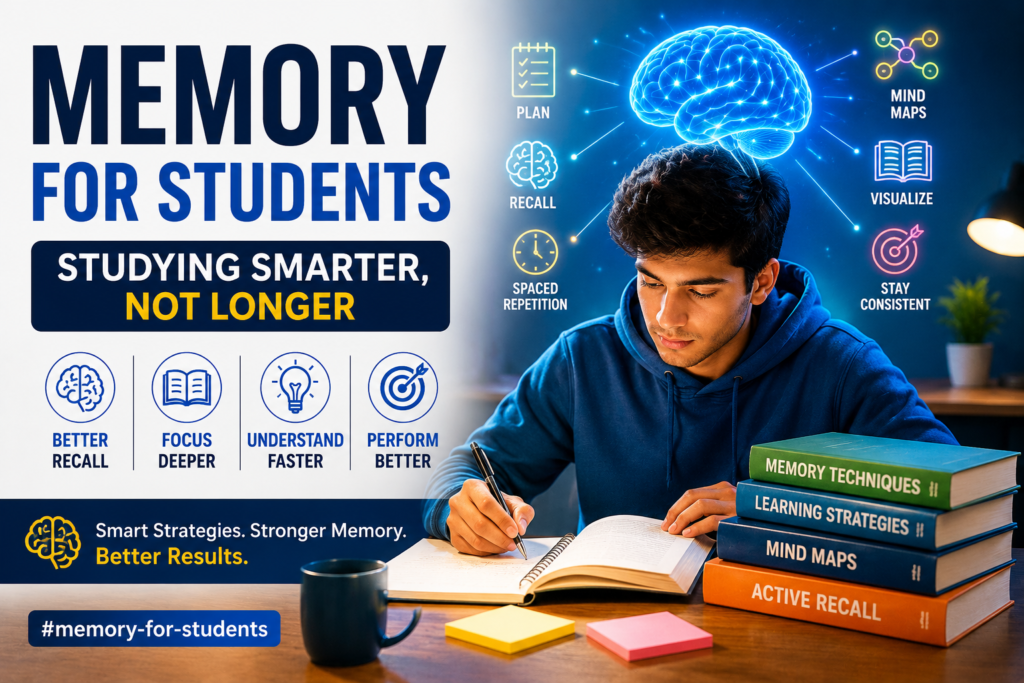
Students often default to the least effective study methods (re-reading, highlighting, cramming) simply because they’re the most familiar and feel productive in the moment. Substituting a few evidence-backed habits can produce dramatically better results without necessarily increasing total study time.
Replace Re-Reading With Active Recall
Instead of reading a chapter multiple times, read it once, close the book, and try to write down or say aloud everything you remember. Then check what you missed and repeat. This single swap is consistently shown to outperform passive re-reading for long-term retention.
Space Out Study Sessions
Instead of a single long cram session, spread the same total study time across several shorter sessions over days or weeks. Even without increasing total hours studied, spacing sessions out measurably improves how much sticks long-term.
Interleave Related Topics
Rather than mastering one topic completely before moving to the next (blocked practice), mix related topics or problem types within a single study session (interleaved practice). This feels harder and less fluent in the moment, but tends to produce stronger long-term learning and better ability to apply knowledge in new situations.
Use Practice Testing Aggressively
Past exams, practice questions, and self-made quizzes are some of the highest-value study tools available, precisely because they force active recall under conditions similar to the actual test. Many students under-use practice testing because it “feels” less comfortable than reviewing familiar notes — that discomfort is often a sign it’s working.
Sleep Before and After Learning
Both a good night’s sleep before a study session (for focus and encoding) and a good night’s sleep afterward (for consolidation) meaningfully affect how much information is retained. Pulling an all-nighter before an exam is one of the most well-documented ways to undermine your own performance, even though it feels like it should help.
Manage Study Environment
- Study in a consistent, distraction-free environment where possible
- Keep your phone out of reach, not just out of sight
- Take short breaks (5-10 minutes) roughly every 25-45 minutes to avoid diminishing returns from sustained, unbroken focus
Mindfulness, Meditation, and Memory {#mindfulness-and-memory}
Mindfulness practice has moved from a niche wellness trend to one of the more consistently studied tools for cognitive health, and its connection to memory is more direct than most people assume.
Why Mindfulness Helps Memory
At its core, mindfulness is a training ground for attention — and as covered earlier, attention is the raw material encoding is built from. When you practice noticing your breath, a sound, or a sensation and gently returning your focus each time your mind wanders, you’re essentially doing reps for the same attentional muscle you rely on every time you meet someone new, sit through a meeting, or study for an exam.
Regular meditators have shown differences in brain regions associated with attention and emotional regulation in various studies, and reduced activity in the stress-response system may also indirectly protect the hippocampus from the kind of chronic cortisol exposure covered earlier in this guide.
You Don’t Need to Meditate for an Hour
A common misconception is that mindfulness only “counts” as a long, formal seated practice. In reality, even brief, consistent practice appears to offer measurable benefits:
- 5-10 minutes of focused breathing each morning
- A single mindful minute before a meeting or study session — just noticing your breath and letting your mind settle before diving in
- Mindful transitions — taking three slow breaths when moving from one task to another, rather than rushing straight through
Informal Mindfulness in Daily Life
You can build attention training into ordinary moments without setting aside dedicated time:
- Eating one meal a day without a screen, paying attention to taste and texture
- Walking without headphones occasionally, noticing your surroundings
- Listening to someone fully in conversation instead of planning your response while they’re still talking
These small practices compound in the same way physical exercise does — the goal isn’t perfection, it’s consistent, repeated practice of returning your attention to the present moment.
Social Connection: The Overlooked Memory Booster {#social-connection}
When people think about improving memory, they usually think about diet, sleep, or brain games — social connection rarely makes the list, despite having some of the strongest long-term research behind it, particularly for protecting memory later in life.
Why Social Interaction Supports Memory
Conversation is cognitively demanding in ways that are easy to overlook. Following a conversation requires holding what was just said in working memory while formulating a relevant response, tracking multiple threads if more than one person is involved, and picking up on tone, context, and nonverbal cues — all simultaneously. This is a genuine cognitive workout, every time you have a real conversation.
Beyond the moment-to-moment mental exercise, strong social ties are associated with lower rates of cognitive decline in long-term studies, and social isolation is one of the more consistently identified risk factors for accelerated cognitive aging.
Practical Ways to Build This In
- Prioritize a small number of regular, meaningful conversations over a large number of shallow ones
- Join a class, club, or group activity that combines learning something new with social interaction — this “stacks” two memory-protective habits at once
- If you live alone or work remotely, be deliberate about scheduling social time rather than assuming it will happen organically
- Volunteer work and mentoring both combine social connection with a sense of purpose, another factor associated with healthy cognitive aging
Memory Techniques Deep Dive: Numbers, Faces, and Languages {#deep-dive-techniques}
The techniques covered earlier in this guide are general-purpose tools. Here’s how to apply them to three of the most common real-world memory challenges people ask about.
Remembering Long Numbers
Phone numbers, PINs, and reference codes are notoriously hard to remember because digits carry no inherent meaning. Two techniques help:
- Chunking, as covered earlier — break the number into groups of 3-4 digits rather than trying to hold it as one long string
- The Major System — a more advanced technique used by memory competitors, where each digit is assigned a consonant sound, allowing long strings of numbers to be converted into memorable words. This has a learning curve but pays off significantly for anyone who regularly needs to memorize numbers (a phone-based sales role, for example)
For everyday use, simply attaching a number to something meaningful — a birth year, an age, a familiar pattern — is often enough to make it stick without needing a formal system.
Remembering Names and Faces
This is one of the most commonly requested memory skills, and it responds well to a specific sequence:
- Make sure you actually hear the name — if you didn’t catch it clearly, ask again immediately rather than nodding along
- Repeat it back — “Nice to meet you, Arjun” reinforces the encoding through active repetition
- Create an association — link the name to a distinctive facial feature, a rhyme, or something they mentioned about themselves
- Use the name again naturally within the conversation, and once more when saying goodbye
The biggest single factor in “forgetting” names isn’t a bad memory — it’s that most people are thinking about their own introduction while the other person is speaking, meaning the name was never properly encoded in the first place.
Learning a New Language Faster
Language learning is a memory-intensive skill that benefits enormously from the techniques covered in this guide:
- Spaced repetition for vocabulary is one of the single highest-leverage habits in language learning, and is the foundation of most modern language-learning apps
- The memory palace works well for vocabulary lists, particularly for languages with unfamiliar scripts or sounds — associating a new word with a vivid mental image tied to a familiar location
- Active recall over passive exposure — simply listening to or reading a language passively builds some familiarity, but actively trying to produce the language (speaking, writing, translating from memory) builds much stronger retention
- Interleaving grammar concepts and vocabulary categories, rather than mastering one small category in isolation before moving to the next, tends to produce more flexible, real-world usable knowledge
Real-World Scenarios: Applying These Habits {#real-world-scenarios}
It’s one thing to read about techniques in the abstract — here’s what applying them looks like in a few common everyday situations.
Scenario: Preparing for an Important Presentation
Instead of reading through your slides repeatedly the night before, try this sequence over several days: outline the key points from memory without looking at your notes, check what you missed, explain the presentation out loud to a friend or even an empty room, then do one final review the morning of, followed by a short walk to settle your nerves and consolidate the material. Get a full night’s sleep beforehand rather than staying up late for a final review — the sleep does more for your recall the next day than an extra hour of cramming will.
Scenario: Remembering Multiple Errands
Rather than trying to hold a list of five stops in your head while driving, either write the list down beforehand or use the memory palace technique — mentally place each errand along your familiar drive route, then simply “look” for them as you pass each landmark.
Scenario: Studying for a Big Exam With Limited Time
Prioritize practice testing and active recall over re-reading, even if it initially feels less comfortable. Space out your remaining study sessions rather than doing one long cram session, get a full night’s sleep the night before rather than sacrificing sleep for extra review, and use interleaved practice — mixing topic areas rather than mastering one completely before moving on — for the strongest long-term retention.
Scenario: Feeling Foggy and Forgetful During a Stressful Period at Work
Rather than trying to power through with more caffeine and less sleep, address the actual drivers: protect your sleep window even when busy, build in short stress-reset breaks throughout the day rather than only after work, move commitments out of your head and into an external system to reduce cognitive load, and be honest with yourself about whether the “bad memory” is really overload rather than a deeper issue.
Building a Daily Memory Routine {#daily-routine}
Here’s what a realistic, sustainable day might look like when you weave together the habits covered throughout this guide. You don’t need to do everything on this list every single day — pick the pieces that fit your life and build consistency before adding more.
| Time | Habit |
|---|---|
| Wake up | Consistent wake time, even on weekends |
| Morning | 10-15 min walk or light exercise; hydrate first thing |
| Breakfast | Include a brain-supportive food (eggs, berries, nuts, oats) |
| Work blocks | Single-task in 25-45 min focused sessions, phone in another room or on silent |
| Learning new info | Use active recall + spaced repetition instead of re-reading or passive review |
| Midday | Short outdoor movement break; batch-check messages instead of reacting in real time |
| Afternoon | 5-10 min stress reset (breathing, brief walk, journaling) if feeling scattered |
| Evening | Wind down 30-60 minutes before bed, dim lights, limit screens |
| Before bed | Briefly review anything important you learned that day |
| Sleep | Aim for consistent 7-9 hours in a cool, dark, quiet room |
A 30-Day Memory Improvement Challenge {#30-day-challenge}
If you want a structured way to put this guide into practice, here’s a simple, low-pressure 30-day framework. Each week adds one new focus area on top of the last, rather than asking you to change everything at once.
Week 1 — Sleep and Hydration Foundation
- Set a consistent sleep and wake time
- Keep a water bottle visible and refill it at set points during the day
- No screens for the last 30 minutes before bed
Week 2 — Add Movement
- Keep everything from Week 1
- 10-15 minutes of movement daily, at any intensity
- One short movement break during your longest work or study block
Week 3 — Add Focused Attention Habits
- Keep everything from Weeks 1-2
- Try single-tasking in 25-minute focused blocks, phone away
- Practice active recall for anything you’re trying to learn or remember that week
Week 4 — Add a Memory Technique
- Keep everything from Weeks 1-3
- Pick one technique from this guide (memory palace, chunking, or spaced repetition) and use it deliberately at least three times this week
- Reflect at the end of the week: which habits felt most sustainable, and which had the most noticeable effect on your focus and recall?
By the end of the 30 days, most people have a much clearer sense of which specific habits move the needle for them personally — memory improvement isn’t one-size-fits-all, and this kind of gradual, stacked approach makes it easier to identify what’s actually working.
Tools and Resources Worth Exploring {#tools-and-resources}
If you want to go beyond habits alone, a few categories of tools can support the routines covered in this guide. As with anything, the tool only works if it fits into a consistent habit — the best app or product is the one you’ll actually use.
Spaced Repetition Software
Flashcard-based apps that automatically schedule reviews at increasing intervals are one of the most evidence-backed digital tools available for anything involving memorization — vocabulary, medical terminology, exam facts, or even names and faces for work. The core mechanic (show you material right before you’re likely to forget it) directly applies the spaced repetition principle covered earlier in this guide.
Habit and Routine Trackers
Since most of what drives memory improvement is consistency in a handful of daily habits (sleep, movement, hydration, focused work blocks), a simple habit tracker — even a basic paper checklist — can help you notice patterns between your habits and how sharp you feel on a given day.
Calendar and External Reminder Systems
As covered in the section on prospective memory, offloading commitments onto a reliable external system is often more effective than trying to improve your ability to “just remember” appointments and tasks internally. A well-maintained calendar, paired with reminders set at the moment you make a commitment (not hours later, when you might forget to set the reminder at all), removes an entire category of memory failure from your daily life.
Journals and Brain Dumps
A simple notebook or notes app used for daily brain dumps — writing out open loops, worries, and to-dos before they build up — supports both the stress-management and cognitive-load-reduction goals covered earlier, without requiring any specialized software.
Evaluating Brain-Health Products
If you’re considering a specific supplement, audio program, or brain-training subscription, a simple evaluation checklist can help you cut through marketing claims:
- Does the product cite specific, checkable research, or only vague references to “studies show”?
- Are the claims proportionate (modest, specific improvements) or does it promise dramatic, fast transformation?
- Are there independent reviews, or only testimonials on the product’s own sales page?
- Is the price and refund policy clearly stated upfront?
- Does the marketing encourage you to also build foundational habits (sleep, exercise, nutrition), or does it position itself as a standalone fix?
Products that pass this kind of scrutiny are far more likely to deliver on realistic expectations than those that don’t.
When to See a Doctor About Memory Problems {#when-to-see-a-doctor}
Most memory struggles described in this guide are within the range of normal, correctable forgetfulness tied to sleep, stress, attention, or lifestyle factors. However, it’s worth talking to a healthcare provider if you or someone close to you notices:
- Memory problems that are progressively getting worse over months, not just an occasional bad week
- Difficulty with tasks that used to be routine and familiar
- Getting lost in previously familiar places
- Trouble following conversations or repeating the same questions or stories within a short period
- Noticeable changes in mood, personality, or judgment alongside memory changes
- Memory problems that are significantly interfering with work, relationships, or daily independence
- Sudden, severe memory loss (which can sometimes indicate an urgent medical issue and should be evaluated promptly)
A healthcare provider can help distinguish between normal age-related changes, lifestyle-driven forgetfulness, and conditions that may need medical evaluation, such as thyroid issues, vitamin deficiencies, sleep disorders, depression (which frequently presents with memory and concentration difficulties), medication side effects, or, less commonly, early signs of a more significant cognitive condition. Early evaluation is helpful in nearly all of these cases, since many underlying causes of memory difficulty are highly treatable when identified.
Frequently Asked Questions {#faq}
How long does it take to improve memory? Small improvements in focus and recall can show up within a couple of weeks of consistent habit changes, particularly around sleep and attention. More structural changes — like increased hippocampal engagement from regular exercise — tend to build over 2-3 months of consistency, and continue compounding over a longer horizon.
Is memory decline with age inevitable? Some slowing in processing speed and occasional word-finding trouble is common with age, but significant memory decline is not an automatic outcome — lifestyle factors play a major, well-documented role in how sharp memory stays across decades.
Can stress really affect memory that much? Yes. Chronic, unmanaged stress is one of the most well-documented factors in everyday memory difficulties, largely through its effect on the hippocampus and its tendency to fragment attention.
Do brain games actually work? They reliably improve your ability to do that specific game, and some show modest transfer to closely related skills, but they work best as one piece of a broader routine — sleep, exercise, nutrition, active recall — not as a standalone fix.
What’s the single best thing I can do for my memory today? If you had to pick just one: fix your sleep. Nearly everything else in this guide — mood, focus, stress resilience, and memory consolidation itself — gets measurably harder to improve when you’re sleep-deprived.
Can diet alone fix memory problems? Diet is an important piece, but it works best combined with sleep, stress management, exercise, and focused attention habits. No single food or supplement reliably compensates for chronic sleep deprivation or unmanaged stress.
Is it normal to forget things more when I’m anxious or overwhelmed? Yes — anxiety and overwhelm both compete for the same limited attentional resources that encoding depends on, so it’s common to feel noticeably more forgetful during particularly stressful periods, independent of any underlying memory issue.
Do memory techniques like the memory palace really work for regular life, not just competitions? Yes, though they take some initial practice to feel natural. Many people find them most useful for specific, structured tasks — remembering a list, a short speech, or key points for a presentation — rather than for everyday, unstructured memory, where good external systems (notes, reminders) tend to be more practical.
Should I try supplements before fixing lifestyle habits? Most evidence suggests the opposite order works better — address sleep, stress, exercise, and nutrition first, since these have the strongest and most consistent research support, then consider whether a specific, well-researched supplement adds meaningful additional benefit on top of that foundation.
Does caffeine help or hurt memory? In moderate amounts, caffeine is associated with short-term improvements in alertness and focus, which can indirectly support encoding. The catch is timing — caffeine has a long half-life, and consuming it too late in the day can quietly reduce deep sleep quality that night, which works directly against the consolidation process memory depends on. Moderate morning or early-afternoon intake tends to offer the benefits without the sleep cost.
Can I improve my memory at any age, or is it too late if I’m older? Neuroplasticity — the brain’s ability to form new connections — persists throughout life, which means meaningful memory improvement is possible at any age. Older adults who adopt the habits in this guide (exercise, sleep, stress management, active learning) consistently show measurable cognitive benefits in research, even when starting later in life. It’s genuinely never “too late” to start, though earlier and more consistent habits compound over a longer runway.
Why do I remember song lyrics from decades ago but forget what I read yesterday? Music engages multiple brain systems simultaneously — rhythm, emotion, and often personal association with a specific time in your life — which creates unusually strong, multi-pathway encoding. Reading a book passively, without emotional engagement or active recall, produces much weaker encoding by comparison. This is actually a useful illustration of the core theme of this guide: it’s rarely about how much “raw memory capacity” you have, and almost always about how strongly something was encoded in the first place.
Is it better to study in the morning or at night? There’s no single universal answer — some people are naturally more alert earlier in the day, others later — but what matters more than time of day is protecting a full night’s sleep after the study session, since that’s when the actual consolidation happens. If you have a choice, studying when you’re naturally most alert, followed by consistent sleep, tends to outperform pushing through fatigue late at night just because it “feels” like more total effort.
Disclaimer: This article is for informational purposes only and is not a substitute for professional medical advice. If you’re experiencing significant or progressively worsening memory problems, please consult a healthcare provider.
Also Read: https://healthteips.com/healthy-breakfast-ideas-for-weight-loss-energy-digestion/
Also Read: https://healthteips.com/dentabiome-review/