How We Researched This Review: This article is based on the product’s official sales and terms pages, cross-checked against independent, peer-reviewed research on binaural beats and gamma-frequency auditory entrainment (cited by name and publication below), and a comparison against multiple third-party review pages covering the same product. We did not use fabricated customer quotes or invented statistics anywhere in this piece — where a claim couldn’t be independently verified, we’ve said so directly instead of presenting it as fact.
It’s 11 PM and You’re Reading About Sound Files Instead of Sleeping (TheBrain Song Review )
You know the feeling. You walked into a room and forgot why. You reread the same paragraph four times because your brain wouldn’t hold onto it. Somewhere between the third cup of coffee and the fifth browser tab, “focus” started to feel like something other people have.
So you did what a lot of people do at midnight: you typed “how to fix brain fog” or “improve memory naturally” into a search bar, and somewhere in the results, a 12-minute audio track kept showing up, promising to nudge your brain into a sharper state just by listening with headphones on.
No pills. No subscriptions. No gym membership for your neurons. Just a song.
It sounds too easy, and if you’ve been burned before by supplements that did nothing but lighten your wallet, your skepticism is earned. That’s exactly why this review exists — not to hype the product up, and not to tear it down for clicks, but to actually look at what’s verifiable, what’s exaggerated, and whether $39 is money well spent or money you’ll be requesting back within the refund window.
Table of Contents
- Quick Facts Box
- What Is The Brain Song?
- How It Works: The Science Behind Gamma Audio
- Key Features & Benefits
- Pros and Cons
- What’s Actually Inside the Program
- What Users Are Reporting
- Science vs. Marketing Claims: A Reality Check
- Pricing, Discounts & Refund Policy
- Side Effects, Risks & Limitations
- Who Should Use It — and Who Shouldn’t
- Our Editorial Rating
- Final Verdict
- FAQs
Quick Facts Box
| Product Type | Digital audio download (gamma-wave brainwave entrainment track) |
| Purpose | Marketed to support focus, memory recall, and mental clarity |
| Official Website | Check Current Pricing & Availability Here |
| Price Range | $39–$69 reported across sources (confirm exact price at checkout — listings vary) |
| Guarantee | 60–90 day money-back guarantee, processed through ClickBank (confirm exact window at checkout) |
| Recommended For | Adults dealing with everyday brain fog, mild focus issues, or stress-related mental fatigue |
| Risk Level | Low financial risk (refund window); moderate risk of disappointment if expectations are unrealistic |
→ Check The Brain Song Official Pricing & 90-Day Guarantee
What Is The Brain Song?
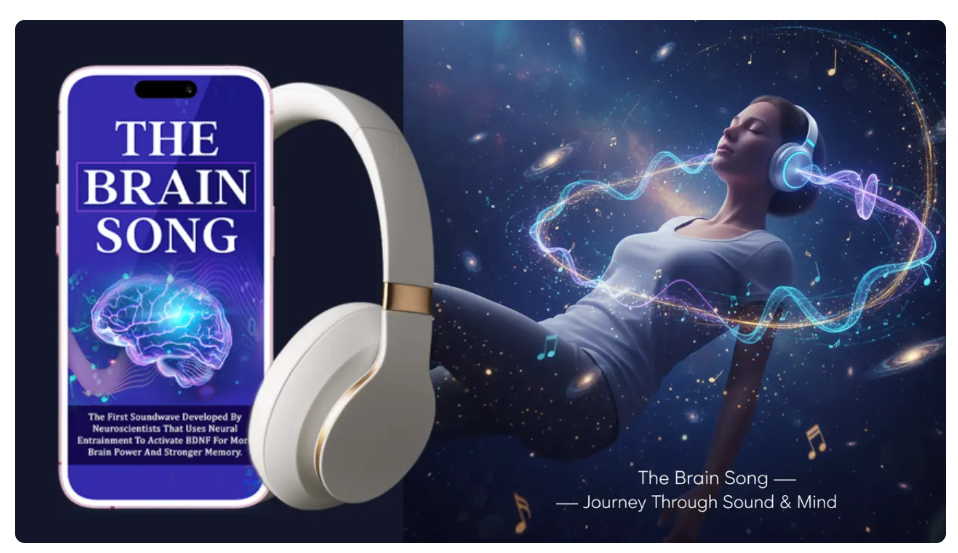
The Brain Song is a digital audio program — not a supplement, not an app with a subscription, not a wearable device. It’s a downloadable track, roughly 12 to 17 minutes long depending on the version you get, that you’re instructed to listen to daily through headphones.
The pitch is built around a concept called brainwave entrainment: the idea that structured sound patterns — layered tones, pulses, and binaural or isochronic beats — can nudge your brain’s electrical activity toward a specific frequency range. In this case, the target is the gamma range, roughly 30–100 Hz, which researchers associate with attention, sensory binding, and working memory.
The marketing also references BDNF (Brain-Derived Neurotrophic Factor), a real protein your body produces that plays a role in neuroplasticity — your brain’s ability to form and strengthen connections. The claim is that gamma-state audio sessions can support the conditions your brain needs to encourage more of this activity.
That’s the pitch in plain English: put on headphones, listen for a few minutes a day, and over time your brain supposedly gets better at doing the things that keep slipping — remembering names, staying on task, thinking clearly under pressure.
Whether that pitch holds up is the actual point of this review, so let’s get into it.
How It Works: The Science Behind Gamma Audio
Strip away the marketing language and the underlying mechanism is genuinely rooted in real neuroscience — brainwave entrainment isn’t invented for this product. Here’s the simplified version.
 The Brain Song targets the gamma range, roughly 30–100 Hz, anchored near 40 Hz — the frequency most studied in relation to attention and memory binding.
Step 1: Your brain naturally produces electrical rhythms. Neurons fire in coordinated patterns, and depending on your mental state, those patterns cluster into different frequency bands — slow delta waves during deep sleep, theta during drowsiness or memory encoding, alpha during relaxed wakefulness, beta during active thinking, and gamma during moments of high alertness, learning, and sensory integration.
Step 2: Rhythmic sound can influence those patterns — sometimes. This is called the “frequency-following response,” and it’s a real, studied phenomenon. But it’s more mixed in the research than most marketing pages let on. A 2023 systematic review published in PLOS ONE by researchers at the University of Duisburg-Essen looked at 14 published studies on binaural-beat entrainment and found the results genuinely inconsistent: 5 studies supported the entrainment hypothesis, 8 contradicted it, and 1 came back mixed, with the reviewers pointing to a lack of standardized methodology across the field as a core problem. On the more encouraging side, a 2023 meta-analysis in the journal Psychological Research by Basu and Banerjee did find a measurable positive effect of binaural beats on memory and attention specifically. In short: this isn’t settled science with a guaranteed effect — it’s a real area of study with genuinely divided results depending on the frequency, protocol, and population tested.
Step 3: The product layers tones designed around roughly 40 Hz, the frequency most associated in gamma research with attention and memory binding, and asks you to listen consistently, on the logic that repeated exposure compounds the effect over time rather than delivering it in one session.
Step 4: The BDNF connection is where things get more speculative. BDNF research is real and well established in neuroscience — but it’s typically studied in the context of exercise, sleep, certain diets, and learning-intensive activity, not passive audio listening. The link between a 12-minute sound file and measurable BDNF increases in humans is not something we found solid, direct clinical evidence for. This is the gap between “the underlying science is real” and “this specific product has been clinically proven to do what it claims” — and it’s a gap worth sitting with before you buy.
Passive, Low-Effort Format
You don’t need to meditate, follow breathing instructions, or do cognitive drills. You press play, put in headphones, and let the track run. For people who’ve tried and abandoned meditation apps or brain-training games because they require too much active engagement, this lower barrier to entry is a genuine practical advantage.
No Ongoing Cost
Unlike subscription-based brain-training platforms or monthly supplement orders, this is sold as a one-time purchase with lifetime access to the file. Once you own it, there’s no recurring charge tied to continued use.
No Physical Side-Effect Profile from Ingredients
Because there’s nothing to swallow, there’s no risk of the kind of interactions or side effects you’d need to worry about with a nootropic supplement — no stimulant crash, no interaction with medication, no digestive issues.
Short Time Commitment
A 12–17 minute daily session is realistic to fit into a morning routine, a commute (if you’re not driving), or a wind-down period, which matters for actual adherence — the best-designed program in the world doesn’t help if you stop using it after four days.
Risk-Buffered by the Refund Window
A 90-day window is genuinely longer than most digital wellness products offer, and it gives you enough time to actually test consistent use rather than judging the product off two sessions.
Pros and Cons
Pros
- Grounded in a real, studied phenomenon (auditory entrainment / frequency-following response)
- Passive and low time commitment — no active exercises required
- One-time payment, no subscription trap
- Long refund window (90 days) relative to most digital products in this space
- No physical ingredients, so no supplement-style side-effect risk
- Accessible price point compared to months of nootropic supplements
Cons
- No independent, peer-reviewed clinical trial specifically on this product — the science cited supports the general category, not this exact track
- BDNF claims are the weakest link in the marketing and go beyond what’s directly demonstrated for passive audio
- Results are inherently subjective and hard to self-measure (no built-in tracking or cognitive testing)
- Marketing language across various promotional pages overstates certainty and, in some cases, contradicts itself on basic facts like who developed it
- Not suitable as a stand-alone approach for anyone with a diagnosed cognitive or neurological condition
- Requires headphones and a quiet environment daily, which isn’t always realistic
There isn’t an “ingredients list” here in the supplement sense — the components are audio engineering choices. Based on how the product describes itself:
Isochronic tones and binaural elements — evenly spaced pulses of sound (isochronic) and slightly different frequencies played in each ear (binaural) are both established entrainment techniques used across sleep, focus, and meditation audio for years, not unique to this product.
A ~40 Hz gamma target — the specific frequency researchers have most often studied in relation to attention and working memory, chosen as the anchor point for the track’s modulation.
Layered ambient texture — softer background tones intended to make the entrainment frequencies tolerable to listen to daily rather than harsh or clinical-sounding, since raw entrainment tones on their own can be genuinely unpleasant.
A short, repeatable session length — designed around adherence rather than intensity, on the theory that a shorter daily habit beats a longer session people skip.
None of this is exotic. It’s a competently framed application of known audio techniques — the honest assessment is that the engineering is plausible, even if the specific cognitive outcomes claimed haven’t been independently verified for this exact file.
What Users Are Reporting
We’re not going to hand you fabricated testimonials dressed up as Reddit posts — you’ll find plenty of review sites doing that, often word-for-word copying each other’s “customer quotes.” Instead, here’s a fair composite of the pattern of feedback that shows up across the product’s own marketing, third-party review pages, and general commentary on brainwave-entrainment products as a category.
The recurring positive theme: people who stick with daily listening for two to four weeks tend to report a subjective sense of calm and mental “reset” more consistently than dramatic memory improvement. Several sources note users describing it as a stress-reduction tool first and a cognitive enhancer second.
The recurring negative theme: the most common disappointment isn’t that the audio does nothing — it’s that it doesn’t deliver the near-instant, dramatic transformation that some of the more aggressive marketing pages imply. Expectation mismatch, not lack of any effect, is the most cited complaint across sources we reviewed.
A secondary complaint: refund processing is described as generally honored, but occasionally slow, with advice from several review sources to keep confirmation emails and contact support early in the window rather than waiting until day 89.
Read skeptically: because this product is sold through a large network of affiliate-driven review sites, a lot of “customer reviews” online are written by marketers rather than actual buyers. Treat glowing five-star language with the same skepticism you’d apply to any incentivized review, ours included — that’s exactly why we’re pointing you toward the pattern rather than manufacturing quotes.
Science vs. Marketing Claims: A Reality Check
| Marketing Claim | What’s Actually Supported | Verdict |
|---|---|---|
| “Gamma entrainment via sound is a real phenomenon” | Studied, but mixed — a 2023 PLOS ONE systematic review of 14 studies found only 5 supported the entrainment hypothesis, 8 contradicted it, and 1 was mixed (Ingendoh, Posny & Heine, 2023) | Real research area, results inconsistent |
| “Gamma activity relates to memory, learning, and attention” | Yes — well established in cognitive neuroscience literature, and a 2023 meta-analysis (Basu & Banerjee, Psychological Research) found a measurable positive effect of binaural beats on memory and attention specifically | Accurate, though effect sizes vary by study |
| “This specific track stimulates BDNF production” | Not independently demonstrated for passive audio listening at this duration | Overstated |
| “Results in days” / “instant genius” language used in some promotional pages | Not supported — entrainment effects, if present, are described in the literature as cumulative and modest | Overstated / marketing exaggeration |
| “Developed by a NASA-trained neuroscientist” / other developer-origin claims | Details vary inconsistently across different promotional sources, which is a credibility red flag worth noting | Unverifiable / inconsistent |
| “90-day money-back guarantee” | Consistently confirmed across independent sources and standard for ClickBank digital products | Accurate |
The honest takeaway: the category of gamma-audio entrainment has real science behind it. The specific, dramatic cognitive claims attached to this one product outrun what’s been independently proven for it. That doesn’t automatically make it a scam — plenty of legitimate wellness products make optimistic marketing claims — but it does mean you should buy this as “a plausible low-risk experiment,” not “a clinically proven cognitive upgrade.”
Pricing, Discount & Refund Policy
Here’s something worth knowing before you click through: pricing for this product is reported very inconsistently across different promotional pages, and that inconsistency is itself useful information.
| Package / Source Claim | Reported Price | Notes |
|---|---|---|
| Single purchase (most common listing) | $39 one-time | The figure cited most consistently across independent review sources |
| Single purchase (higher-tier promo pages) | $49–$69 | Some pages quote a higher “regular” price framed against a discount |
| “1 Bottle” / “3 Bottles” / “6 Bottles” bundle promo | $69 / $177 / $294 | ⚠️ Seen on at least one promotional page — note this is a digital audio file, not a bottled product, so “bottle” bundle pricing with “free shipping” language is a template mismatch worth being cautious about |
| Refund window | 60–90 days (varies by source) | Most listings say 90 days; a few say 60 — confirm the exact figure shown at your specific checkout |
Why this matters: when a product’s own promotional ecosystem can’t agree on its own price or refund terms, that’s not proof of a scam, but it is a sign of a loosely controlled affiliate funnel where different landing pages are run by different marketers with different (sometimes outdated or copy-pasted) sales copy. Always confirm the actual price and refund window on the live checkout page before entering payment information — don’t rely on any one article, including this one, for the final number.
→ Check The Brain Song Official Pricing & 90-Day Guarantee
What is consistent across every source we checked: it’s a one-time digital purchase, not a subscription, with no recurring billing, and refunds are processed through ClickBank (the payment retailer) rather than the product creator directly.
Side Effects, Risks & Limitations
Because there’s no ingestible ingredient involved, this isn’t a product with a supplement-style side-effect profile. That said, honesty requires flagging a few real limitations:
- Auditory entrainment audio has, in rare cases, been associated with headaches, mild dizziness, or a “mentally tired” feeling, particularly early on or with poor-quality/counterfeit audio files. Using the official file at a reasonable volume, rather than pirated or re-encoded copies, matters here.
- Not appropriate as a stand-alone tool for diagnosed neurological conditions such as epilepsy, where rhythmic auditory or visual stimulation warrants caution — anyone with a seizure disorder or another neurological diagnosis should talk to a doctor before trying any entrainment audio.
- It is not a substitute for medical evaluation of memory loss, cognitive decline, or attention difficulties that are significant or worsening. Persistent brain fog can have real, treatable underlying causes (sleep disorders, thyroid issues, medication side effects, depression, ADHD, and more) that a $39 audio track cannot diagnose or address.
- Results are subjective and unmeasured. There’s no built-in cognitive testing to track whether you’re actually improving versus simply feeling more relaxed from a daily 12-minute quiet moment — which, to be fair, has its own legitimate value.
Who Should Use It — and Who Shouldn’t
Likely a reasonable low-risk try for:
- Adults dealing with everyday stress-related brain fog, not a diagnosed condition
- People who want a passive, low-effort daily habit rather than active brain-training exercises
- Students or professionals looking for a calming pre-study or pre-work ritual
- Anyone who’s already comfortable with the refund process and wants to test it risk-buffered
Probably not the right fit for:
- Anyone with epilepsy or a seizure disorder, without medical clearance first
- People expecting a fast, dramatic, clinically-proven cognitive upgrade
- Anyone whose memory or focus issues are severe, sudden, or worsening — see a doctor first
- People who want hard, measurable data on their cognitive improvement rather than a subjective sense of clarity
Our Editorial Rating
| Category | Score | Why |
|---|---|---|
| Effectiveness | 6/10 | The underlying science (entrainment, gamma/attention links) is real; the product-specific outcome claims are not independently proven |
| Safety | 8/10 | No ingestible risk; minor caution warranted for anyone with a seizure disorder |
| Value for Money | 7/10 | $39 with a 90-day refund window is a reasonable, low-risk price point for a digital wellness experiment |
| User Satisfaction (as reported) | 6.5/10 | Feedback pattern skews positive for stress/calm, mixed for dramatic memory claims, with expectation mismatch as the main complaint |
| Overall | 6.9/10 | A plausible, low-risk daily habit — not a clinically validated cognitive enhancer |
Final Verdict: Is The Brain Song Worth It?
Here’s the balanced answer, no hedging: The Brain Song is not a scam in the sense of “there’s nothing real here.” The underlying science — brainwave entrainment, gamma-frequency research, the general relationship between attention states and neural oscillation — is legitimate and studied. What’s oversold is the certainty with which some marketing pages present dramatic, fast cognitive transformation and specific BDNF outcomes that haven’t been independently demonstrated for this exact audio file.
If you go in expecting a daily 12-minute reset that might help you feel calmer, more focused, and more consistent — and treat any memory or clarity improvement as a welcome bonus rather than a guarantee — this is a low financial risk way to find out if it works for you, especially with a 90-day window to change your mind. If you’re expecting a scientifically bulletproof, clinically validated brain upgrade, temper those expectations before you buy, because that specific bar hasn’t been cleared by the evidence currently available.
Realistic recommendation level: worth trying cautiously, with clear expectations, and only if you’ve ruled out that persistent brain fog isn’t a sign of something a doctor should look at first.
Frequently Asked Questions
Does The Brain Song really work? The entrainment science behind it is real, and many users report feeling calmer and more focused with consistent daily use. Whether it delivers the specific memory and BDNF outcomes advertised is not independently proven — treat it as a plausible tool, not a guaranteed fix.
Is The Brain Song a scam or legit? It’s a legitimately sold digital product with a real, established refund process through ClickBank. The concern isn’t that it’s a scam outright — it’s that some of the marketing claims around it are more confident than the current evidence supports.
How long does it take to see results? Most reported feedback describes a subjective effect (calm, mental “reset”) within the first couple of weeks, with any further improvement described as gradual rather than immediate.
Are there any side effects? No ingredient-based side effects since it’s audio-only. Some entrainment audio has been associated with mild headache or dizziness in a minority of users, and rhythmic auditory stimulation warrants caution for anyone with a seizure disorder.
How much does The Brain Song cost? Around $39 for one-time, lifetime access at the time of writing. Always confirm current pricing at checkout, since promotional pricing can change.
Is there a money-back guarantee? Yes — a 90-day refund window processed through ClickBank. Keep your order confirmation and contact support early in the window if you decide to request a refund.
Do I need any special equipment? Just headphones and a phone or computer to play the file. No wearable devices or additional hardware required.
Can it replace medical treatment for memory problems? No. It’s a wellness audio product, not a medical device or treatment, and it isn’t a substitute for evaluation by a doctor if you’re experiencing significant or worsening cognitive symptoms.
Who shouldn’t use it? Anyone with epilepsy or a seizure disorder should check with a doctor first. Anyone expecting an instant, dramatic cognitive transformation should recalibrate expectations before buying.
Where can I buy the real version? Only through the official checkout page — several review sources note counterfeit or re-uploaded versions circulating, which strip out the refund protection and may not match the tested audio calibration.
Check Official Website for Latest Offers & Details
If you’ve read this far and decided the low-risk, expectations-in-check approach makes sense for you, you can review current pricing and the refund terms directly here:
→ Check The Brain Song Official Pricing & 90-Day Guarantee
Editorial Disclosure: This article contains an affiliate link. If you purchase through it, we may earn a commission at no extra cost to you. That relationship does not change our analysis below — we’ve flagged both the strengths and the weak points of this product’s claims.