
Walking through a grocery store can feel like a series of quick decisions. One package says “high protein,” another says “natural,” and another claims to be “low fat.” But marketing words on the front of a package do not always tell you the full nutrition story.
Learning how to read nutrition labels gives you a more reliable way to understand what you are actually buying and eating. The Nutrition Facts label can help you compare products, check serving sizes, understand calories, evaluate nutrients, and spot added sugars or high amounts of sodium.
Whether you are trying to eat a more balanced diet, manage your portions, increase your fiber intake, or simply become more informed about nutrition, knowing how to use a food label is a practical everyday skill.
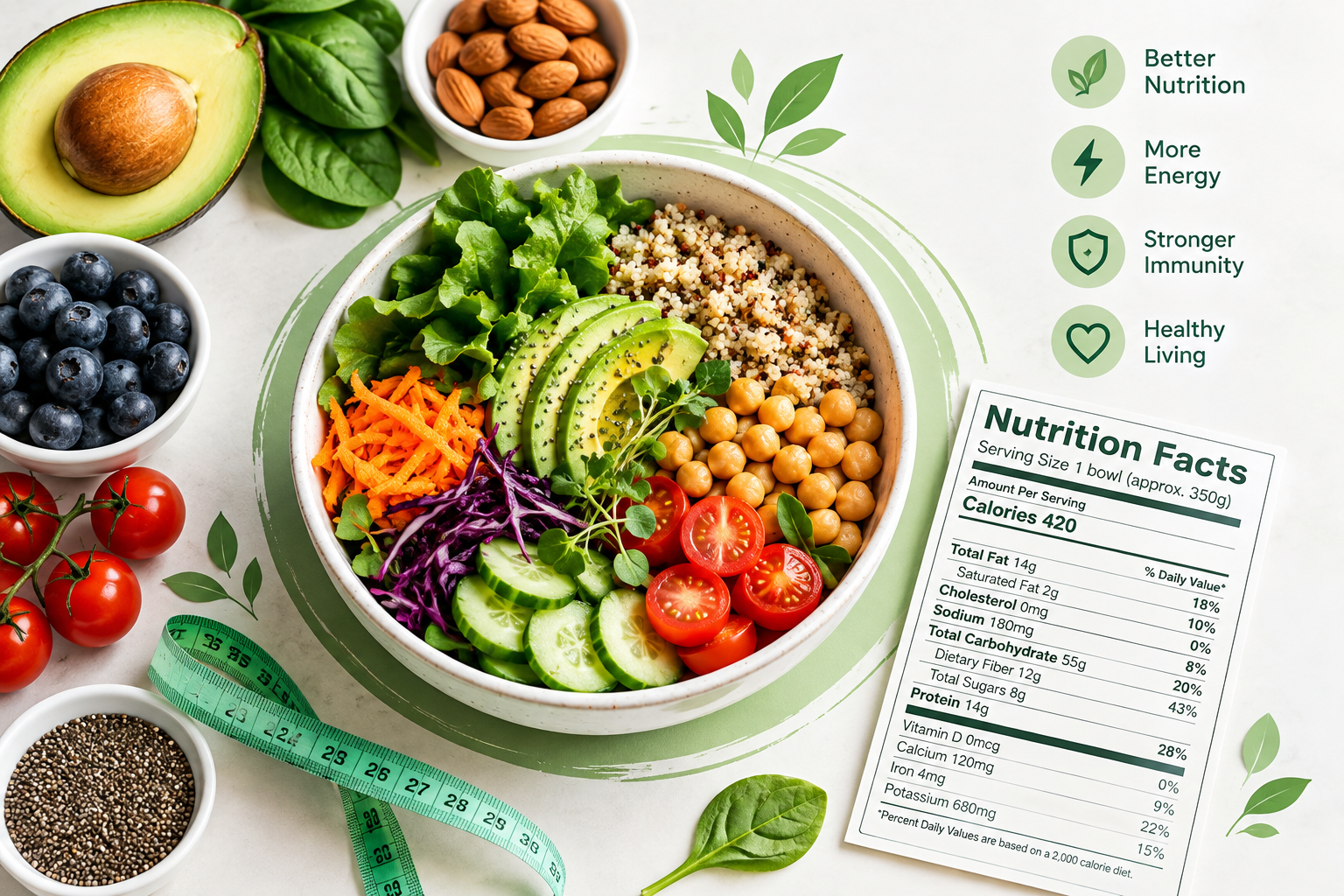
Quick Answer: How Do You Read a Nutrition Label?
Start with the serving size, then check the number of servings per container. Next, look at calories and the nutrients that matter most to your dietary needs. Pay particular attention to saturated fat, sodium, added sugars, dietary fiber, protein, and nutrients such as calcium, iron, potassium, and vitamin D.
Finally, check the % Daily Value (%DV) and read the ingredient list. In general, the FDA considers 5% DV or less to be low and 20% DV or more to be high for a nutrient.
Simple rule: Do not judge a food by one number. Look at the whole label and consider how the food fits into your overall diet.
Why Nutrition Labels Matter
Nutrition labels are designed to give consumers useful information about packaged foods and beverages. In the United States, the FDA requires a Nutrition Facts label on most packaged foods, with information such as serving size, calories, fat, carbohydrates, protein, sodium, and selected vitamins and minerals.
This information can be useful when you want to:
- Compare two similar products
- Understand portion sizes
- Reduce added sugar
- Watch sodium intake
- Increase dietary fiber
- Choose foods with more protein
- Compare calories between products
- Identify important vitamins and minerals
- Check ingredients for food allergies
Nutrition is not about finding one “perfect” food. It is about understanding what you are eating and making choices that fit your individual needs.
Step 1: Check the Serving Size First
The serving size is one of the most important parts of the label because the nutrition information that follows is generally based on that amount.
For example, imagine a snack package says:
| Nutrition information | Per serving |
|---|---|
| Serving size | 1 ounce |
| Calories | 150 |
| Total fat | 8g |
| Sodium | 180mg |
| Total carbohydrate | 18g |
| Protein | 3g |
If the package contains three servings and you eat the entire package, you have eaten three servings. That means the calories and nutrients would be three times the listed amount.
The FDA specifically notes that a serving size is not a recommendation of how much you should eat. It is a standardized amount used to present the nutrition information.
A Simple Serving-Size Checklist
Before looking at calories or nutrients, ask:
- What is the serving size?
- How many servings are in the package?
- How much am I actually eating?
- Is the package intended to be eaten in one sitting?
- Does the package provide information for the entire container?
Some packages may use a dual-column label showing nutrition information per serving and per package, which can make comparisons easier.
Step 2: Look at the Calories
Calories tell you how much energy one serving provides.
Calories can be useful when managing overall food intake, but calories alone do not tell you whether a food is nutritious.
For example, two foods may contain a similar number of calories but provide very different amounts of protein, fiber, vitamins, minerals, sodium, or added sugars.
That is why calories should be considered alongside the rest of the Nutrition Facts label.
Calories vs. Nutritional Quality
| What you check | What it tells you |
|---|---|
| Calories | Energy provided |
| Protein | Amount of protein per serving |
| Fiber | Dietary fiber provided |
| Added sugars | Sugar added during processing |
| Sodium | Amount of sodium |
| Saturated fat | Amount of saturated fat |
| Vitamins/minerals | Selected micronutrient contribution |
The goal is not automatically to choose the product with the fewest calories. Instead, consider what the food provides for those calories and how it fits into your overall eating pattern.
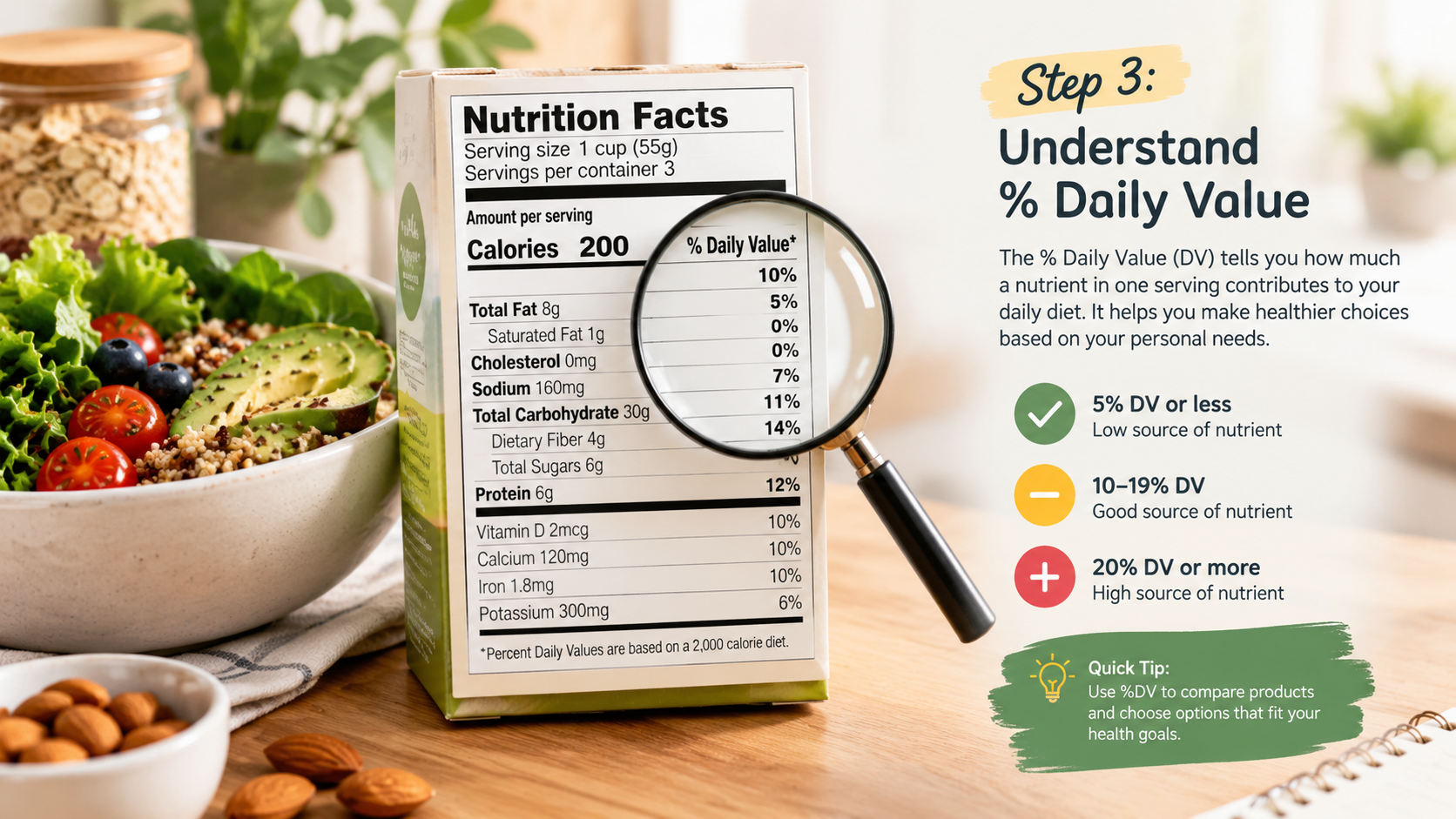
Step 3: Understand % Daily Value
The % Daily Value (%DV) tells you how much a nutrient in one serving contributes to a daily diet.
The FDA’s general guide is:
- 5% DV or less = low
- 20% DV or more = high
These values can help you compare foods quickly.
For example, if one cereal has 4% DV of sodium and another has 22% DV, the second cereal provides a much larger percentage of the Daily Value for sodium per serving.
However, remember to compare products using similar serving sizes.
What Does 20% DV Mean?
If a food contains 20% DV of a nutrient, one serving provides about one-fifth of the Daily Value used for that nutrient on the label.
Daily Values are reference amounts used on food and supplement labels. They are not necessarily the same as an individual’s personal nutrition requirements. NIH explains that RDAs can vary according to factors such as age and sex, whereas a single DV is used on food labels for people age 4 and older.
Step 4: Pay Attention to the Nutrients
Once you understand serving size and %DV, look at the nutrients.
The current Nutrition Facts label includes information such as total fat, saturated fat, trans fat, cholesterol, sodium, total carbohydrate, dietary fiber, total sugars, added sugars, and protein. Vitamins and minerals including vitamin D, calcium, iron, and potassium are also listed.
Dietary Fiber
Fiber is a carbohydrate that can be an important part of a balanced diet.
When comparing similar products, checking the fiber amount can help you identify which option provides more fiber per serving.
Foods that naturally contain fiber include vegetables, fruits, beans, lentils, whole grains, nuts, and seeds.
Protein
Protein is another useful number to check, particularly when comparing foods such as yogurt, cereal, snack bars, canned foods, or plant-based products.
A higher protein number does not automatically make a product healthier. Consider protein together with calories, saturated fat, sodium, added sugars, and the ingredient list.
Sodium
Sodium is especially useful to check when comparing packaged foods.
The FDA lists 2,300 mg as the current Daily Value for sodium.
Two foods can look similar on the front of the package but have very different sodium levels, so checking the Nutrition Facts panel can reveal differences that marketing claims may not show.
Saturated Fat
The label also provides information about saturated fat.
The current FDA Daily Value for saturated fat is 20 grams.
When comparing similar foods, checking saturated fat can help you make a more informed choice based on your overall dietary goals.
Step 5: Learn the Difference Between Total Sugar and Added Sugar
This is one of the most useful things to understand when learning how to read nutrition labels.
Total sugars include naturally occurring sugars as well as added sugars.
Naturally occurring sugars can be found in foods such as fruit and milk. Added sugars are sugars added during processing or preparation.
The FDA lists 50 grams per day as the Daily Value for added sugars, based on a 2,000-calorie diet. The Dietary Guidelines for Americans recommends limiting calories from added sugars to less than 10% of total calories per day.
Example
Suppose a yogurt label says:
- Total sugars: 15g
- Added sugars: 7g
The total sugar includes both naturally occurring and added sugar. The added sugar is part of that total rather than an additional 7g on top of it.
This distinction can help you understand labels without automatically treating all sugars as identical.
Step 6: Read the Ingredient List
The Nutrition Facts panel is only part of the label.
The ingredient list can tell you what the product is actually made from. Ingredients are generally listed in descending order by weight.
If you are comparing two similar products, look at the ingredient lists alongside their Nutrition Facts panels.
For example, you may want to check whether a product contains:
- Whole grains
- Nuts or seeds
- Added sweeteners
- Oils
- Artificial or natural flavors
- Preservatives
- Different forms of sugar
- Ingredients you personally avoid
People with food allergies should pay particular attention to the ingredient information. U.S. food-labeling requirements identify nine major food allergens: milk, egg, fish, crustacean shellfish, tree nuts, wheat, peanuts, soybeans, and sesame.
Step 7: Compare Similar Products
One of the best uses of a nutrition label is comparing similar products.
Imagine you are choosing between two breakfast cereals:
| Nutrient | Cereal A | Cereal B |
|---|---|---|
| Serving size | 1 cup | 1 cup |
| Calories | 190 | 210 |
| Fiber | 3g | 7g |
| Added sugar | 10g | 4g |
| Sodium | 220mg | 140mg |
| Protein | 4g | 6g |
Looking at calories alone would not tell you the full story.
Cereal B has more fiber and protein and less added sugar and sodium, while also containing slightly more calories. Depending on your dietary priorities, several pieces of information may matter more than the calorie difference.
This is why nutrition labels work best as a comparison tool rather than a simple “good food versus bad food” test.
A 30-Second Nutrition Label Checklist
You do not need to study every package for five minutes.
Use this quick process when shopping:
1. Serving size
Check how much one serving actually is.
2. Servings per container
Find out whether the package contains multiple servings.
3. Calories
See how much energy one serving provides.
4. Added sugar
Check both grams and %DV.
5. Sodium
Compare sodium levels between similar products.
6. Fiber
Look for foods that provide useful amounts of dietary fiber.
7. Protein
Consider protein in the context of the entire product.
8. Saturated fat
Compare similar products when this is relevant to your diet.
9. Vitamins and minerals
Look at nutrients such as calcium, vitamin D, iron, and potassium.
10. Ingredients
Read the ingredient list before making your final choice.
Common Mistakes People Make When Reading Nutrition Labels
Looking Only at Calories
Calories are important, but they do not tell you everything about a food.
A food with slightly more calories may provide substantially more protein, fiber, or micronutrients.
Ignoring Serving Size
This is one of the easiest mistakes to make.
If the label lists 150 calories per serving but you eat two servings, you consumed 300 calories from that product.
Confusing Total Sugar With Added Sugar
Total sugar includes naturally occurring sugar and added sugar. The added sugar line helps you identify the portion that comes from sugars added during processing or preparation.
Assuming “Natural” Means Healthy
Words on the front of a package can be useful, but they should not replace the Nutrition Facts label and ingredient list.
Comparing Different Serving Sizes
If one product lists nutrition per 1 ounce and another lists it per 2 ounces, comparing the numbers directly can be misleading.
Try to compare similar serving amounts.
How Nutrition Geeks Can Use Labels More Effectively
For people who enjoy learning about nutrition, food labels provide a practical way to turn nutrition knowledge into everyday decisions.
Rather than memorizing every nutrient number, focus on a few habits:
- Compare similar products.
- Check serving sizes.
- Use %DV as a quick reference.
- Look at added sugars.
- Pay attention to sodium.
- Check fiber and protein.
- Read the ingredient list.
- Consider the entire diet rather than one food.
The goal is not to become obsessed with every number. It is to become comfortable enough with nutrition labels that you can make informed choices quickly.
Nutrition Label Comparison: What Should You Look At First?
| Priority | What to check | Why it matters |
|---|---|---|
| 1 | Serving size | Puts every number into context |
| 2 | Calories | Shows energy per serving |
| 3 | Added sugar | Helps identify added sugars |
| 4 | Sodium | Useful when comparing packaged foods |
| 5 | Fiber | Helps compare fiber content |
| 6 | Protein | Useful for comparing protein contribution |
| 7 | Saturated fat | Helps compare fat profiles |
| 8 | Ingredients | Shows what the food contains |
| 9 | Vitamins/minerals | Helps assess selected micronutrients |
There is no single order that works for everyone. If you have a specific dietary goal or medical condition, the nutrients you prioritize may be different.
A Simple Example of Reading a Label
Imagine you are buying a packaged granola bar.
The front says:
“High Protein • Made With Whole Grains • Natural Ingredients”
Instead of making a decision based only on those claims, turn the package around.
First, check the serving size. Then look at calories, protein, fiber, saturated fat, sodium, total sugar, and added sugar.
Finally, read the ingredients.
You might discover that two bars with similar front-of-package claims have very different amounts of added sugar, fiber, or sodium.
This simple habit—front of package for marketing, back of package for details—can make grocery shopping more informed.
Key Takeaways
Learning how to read nutrition labels does not require advanced nutrition knowledge.
Remember these core principles:
- Start with serving size.
- Check servings per container.
- Look at calories in context.
- Use %DV to compare nutrient amounts.
- Remember that 5% DV or less is generally considered low and 20% DV or more high.
- Check added sugar separately from total sugar.
- Compare sodium, saturated fat, fiber, and protein.
- Read the ingredient list.
- Compare products using similar serving sizes.
- Consider the entire eating pattern rather than judging one food by one nutrient.
Nutrition labels are tools, not a grading system for food. The most useful approach is to understand the information and use it alongside your overall dietary needs, preferences, and health goals.
Frequently Asked Questions
1. What is the easiest way to read a nutrition label?
Start with the serving size, then check calories, added sugar, sodium, fiber, protein, and saturated fat. After that, review the % Daily Value and ingredient list.
2. What does 20% Daily Value mean on a nutrition label?
A 20% DV means one serving provides 20% of the Daily Value for that nutrient. The FDA generally considers 20% DV or more to be high and 5% DV or less to be low.
3. What is the difference between total sugar and added sugar?
Total sugar includes naturally occurring sugars and added sugars. Added sugar refers to sugars added during processing or preparation.
4. Should I choose foods with the lowest calories?
Not necessarily. Calories are only one part of nutrition. It is also useful to consider protein, fiber, sodium, saturated fat, added sugar, vitamins, minerals, and the ingredient list.
5. Why is serving size important when reading food labels?
Nutrition information is generally provided for one serving. If you eat multiple servings, you need to account for each serving to understand how much energy and nutrients you consumed.